
This leaflet gives you information that will help you decide whether to have cataract
surgery. You might want to discuss it with a relative or carer. Before you have the
operation, you will be asked to sign a consent form and so it is important that you
understand the leaflet before you decide to have surgery. A copy of the consent form
you will be asked to sign can be found on page 9 and 10. Please read this before you
arrive at the hospital.
If you have any questions, you may wish to write them down in the box on page 6, so
that you can ask one of the hospital staff.
The cataract
Your eye surgeon has recommended cataract surgery because the lens in your eye has become cloudy making it difficult for you to see well enough to carry out your usual daily activities. If the cataract is not removed, your vision may stay the same, but it will probably gradually get worse. Waiting for a longer period of time is unlikely to make the operation more difficult, unless your eyesight becomes so poor that all you can see is light and
dark.

The operation
The purpose of the operation is to replace the cloudy lens (cataract) with a plastic lens
(implant) inside your eye.
• An experienced eye surgeon will carry out the operation or may supervise a doctor
in training who also performs some operations.
• Please do not wear any face or eye makeup on the day of surgery
• You will be able to go into theatre wearing your own clothes
• Dentures (if you wear them) need not be removed
• You will come to the Ophthalmic Surgical Unit (OSU) to be prepared for your
operation
• In the hour before the operation you will have a pellet put in the lower eye lid.
This will enlarge the pupil ready for surgery.
• After this you will be escorted to the anaesthetic room in the theatre where you will
be given an anaesthetic to numb the eye. This may consist simply of eye drops or
injecting local anaesthetic solution into the tissue surrounding the eye. After the
anaesthetic you will not feel any discomfort or pain.
With a local anaesthetic you will be awake during the operation. You will not be able to
see what is happening, but you will be aware of a bright light.
You will be escorted to theatre where your operation will take place. A monitor will be
clipped onto one of your fingers to monitor your pulse. The area around your eye is
cleaned and then a light sterile drape will cover your face and chest. A tube underneath
the drape gently blows out some fresh air therefore you will be able to breathe normally.
During the operation you will be asked to keep your head still, and lie as flat as
possible.
A member of the nursing staff is usually available to hold your hand during the
operation, should you want them to.
The lids of the eye to be operated on, will be held open with a small instrument.
You will be asked to refrain from talking during the operation but you can be assured that a nurse will be present to ensure that you are comfortable. The operation normally takes takes 20-30 minutes, but may take up to 45 minutes. Most cataracts are removed by a technique called phacoemulsification, in which the surgeon makes a very small cut in the
eye, softens the lens with sound waves and removes the cataract through a small tube.
The back layer of the lens is left behind. An artificial lens (implant) is then inserted
to replace the cataract. Sometimes a small stitch is put in the eye. At the end of the
operation, a pad or shield may be put over your eye to protect it.

After the operation
If you have discomfort, we suggest that you take a pain reliever such as paracetamol
every 4-6 hours (but not aspirin – this can cause bleeding). It is normal to feel itching,
sticky eyelids and mild discomfort for a while after cataract surgery. Some fluid
discharge is common. After a few days even mild discomfort should disappear. In most
cases, healing will take upto 6 weeks, after which new glasses can be prescribed by
your optician. You will be given eye drops to reduce inflammation. The hospital staff will
explain how and when to use them. Please don’t rub your eye. Certain symptoms could
mean that you need prompt treatment, including:
• Excessive pain
• Loss of vision
• Increasing redness of the eye
You will be given an emergency telephone number to ring in case you develop any of
the above, or should you need urgent advice about your eye.
Monday-Friday, 9am-5pm 01253 957420
Out of hours and weekends in case of an emergency please contact Surgical
High Care – Tel. 01253 953414.
Likelihood of better vision
After the operation you may read or watch TV almost straight away, but your vision may
be blurred. The healing eye needs time to adjust so that it can focus properly with the
other eye, especially if the other eye has a cataract.
The vast majority of patients have improved eyesight following cataract surgery.
Please note that if you have another condition such as diabetes, glaucoma or agerelated
macular degeneration your quality of vision may still be limited even after
successful surgery.
Benefits and risks of cataract surgery
The most obvious benefits are greater clarity of vision and improved colour vision.
Because lens implants are selected to compensate for existing focusing problems, most
people find that their eyesight improves considerably after surgery but you will need to
replace your glasses. Reading glasses are usually needed after cataract surgery.
However, you should be aware that there is a small risk of complications, either during
or after the operation.
Some possible complications during the operation
• Tearing of the back part of the lens capsule with disturbance of the gel inside the
eye that may sometimes result in reduced vision.
• Loss of all or part of the cataract into the back of the eye requiring a further
operation which may require a general anaesthetic.
• Bleeding inside the eye.
Some possible complications after the operation.
• Bruising of the eye or eyelids.
• High pressure inside the eye.
• Clouding of the cornea.
• Incorrect strength or dislocation of the implant.
• Swelling of the retina – macular oedema.
• Detached retina which can lead to loss of sight.
• Infection in the eye – endophthalmitis – which can lead to loss of sight, or even loss
of the eye.
• Allergy to the medication used.
• Several complications listed above may result in permanent sight loss.
Complications are rare and in most cases can be treated effectively. In a small
proportion of cases, further surgery may be needed. Very rarely some complications
can result in blindness.
The most common complication is called ‘posterior capsular opacification’. It may come on
gradually after months or years after cataract surgery. When this happens, the back part
of the lens capsule, which was left in the eye to support the implant, becomes cloudy. This
prevents light from reaching the retina. To treat this, the eye specialist uses a laser beam
to make a small opening in the cloudy membrane in order to improve the eyesight.
This is a painless outpatient procedure which normally takes only a few minutes.
We hope this information is sufficient to help you decide whether to go ahead with surgery.
Please use the space below to write down any further questions to ask the doctor or
nurse when you come to the hospital for your appointment. Don’t worry about asking
questions. Our staff will be happy to answer them.
Checklist: One week before cataract surgery
1. Ensure that your blood glucose levels are stable if you are diabetic (below 21mmol/l).
2. Ensure your blood pressure is below 180/90 if you suffer from high blood
pressure.
3. Your warfarin blood levels must be check within one week of surgery and within
range if not please contact the unit.
4. Take all medications as normal upto and including the day of surgery.
5. Arrange transport to arrive in time for your appointment.
6. If you develop any illnesses, coughs, colds or any medical or eye conditions
please let us know by phoning 01253 957420. This will prevent you being
cancelled on the day and the operation slot can be offered to someone else.
7. You will not be able to drive home yourself so please ensure you have someone
with you and a means of transport home.
Checklist: The day before surgery
1. Ensure the above are completed.
2. You can eat or drink as normal.
3. Bring with you a list of your medication. It maybe that the doctor will wish to see
this.
4. Take your normal medication. If you take warfarin, and you know your levels are
abnormal you must ring the department as soon as you can.
5. Have the telephone number with you of the person taking you home.
Instructions for the day of surgery
1. Report to the reception desk upon arrival to the hospital
2. If you are having a local anaesthetic you can have a light meal prior to the
surgery.
3. You should continue to take all medications for blood pressure, heart problems,
asthma and epilepsy. Please bring your daily medications with you (in their
original containers) on the day of your operation.
4. Leave all jewellery and large sums of money at home. Bring just enough money
for a taxi ride home. The hospital assumes no responsibility in the case of loss.
5. You will be asked to remove all make-up and hair ornaments. Rings that cannot
be removed will be secured with tape. Please remember to bring your contact
lens container.
6. If you are to have a general anaesthetic, an intravenous drip may be started
before your procedure.
7. You are NOT TO DRIVE after receiving a general anaesthetic or sedation. You
must arrange for a responsible adult to drive you to and from the hospital. You
must not operate hazardous machinery, drive a car or sign important documents for 48 hours
8. Wear loose, comfortable clothing.
After your surgery, you may return to the hospital recovery area for a short time, where
you will be given something to eat and drink.
Post-operative care
After your surgery we would like you to go home and take it easy.
You are NOT to use any eye drops that evening.
Please do not rub or touch the eye.
It is normal for your eye to feel some itching and mild discomfort after surgery.
Some discharge is also common and your eye may be sensitive to lights.
If there is slight discomfort you can use a mild pain reliever (paracetamol).
If you experience a lot of pain or a decrease in your vision, you should contact the hospital. This is not normal.
1. Avoid lifting anything over 20 lbs. or 9 kilos in weight for two weeks (Children,
groceries etc.).
2. Avoid water sports or swimming for two weeks.
3. You can have a shower but avoid getting water or soap into the operated eye.
4. You can wash your hair by tilting your head backward as at the hairdressers.
i. Certain sports activities need to be avoided (i.e. bowling, Swimming) for a time, usually 2 weeks.
ii. If you still work, it will depend upon your job when it would be safe to go back to work. Please discuss with your doctor.
iii. You may drive if you are legally able to do so. Some patients may need to wait 3-4 weeks until they have new glasses prescribed. Your optician will be able to advise you if you meet the legal driving standard.
Please discuss any activities you would like to participate in with the doctor.
Directions to the Ophthalmic Surgical Unit (OSU)

How to get here
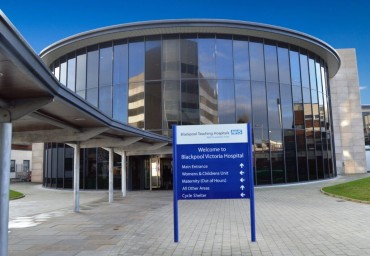
The hospital is adjacent to Blackpool Zoo.
From the A538 Preston New Road turn onto South Park Drive, which becomes East Park
Drive. For the Southern entrance to the Hospital, turn right at the set of traffic
lights after the entrance to the Zoo.
For the Northern entrance, carry on to four lane ends roundabout. Take the fourth exit and turn right into Whinney Heys Road.
Hospital Policy
The Ophthalmic Surgical Unit is located in area 5. The Department is signposted from inside the hospital.
Smoking - The Trust operates a no smoking policy and your cooperation with this is appreciated
Health and Safety - Our patients may have por vision, please consider their safety by cooperating with the following:
- Try not to obstruct the corridor
- To reduce the risk of injury to you and other patients, Please avoid assisting others
Facilities available on the Unit
- Music via CD Player or radio in the postoperative area
- Telephone for making out-going calls.
- Chilled water fountain
We are aware this PDF are might not be accessible to all users. If you would like to request an accessible version, please contact bfwh.
Read our accessibility statement to learn more.
Author Ophthalmic Department
Approved by Ophthalmology Governance Meeting
Date of Publication 13/11/2025
Review Date 01/11/2028
Reference No PL/502 (V6)